Total: £0.00
Taxes and shipping calculated at checkout
Wood is the first thing people ask about when they order a personalised wooden chopping board. Size is what goes wrong. A 27 × 12.5cm oak board and a 40 × 30cm acacia board are both "a chopping board" on a product page, and on a kitchen counter they behave like different objects.
We engrave oak and acacia boards. We don't make a bamboo board, though bamboo is a common thing to ask about, so it gets an honest section below. This is how the three woods take an engraving, wear, and cost, and which one suits which person.
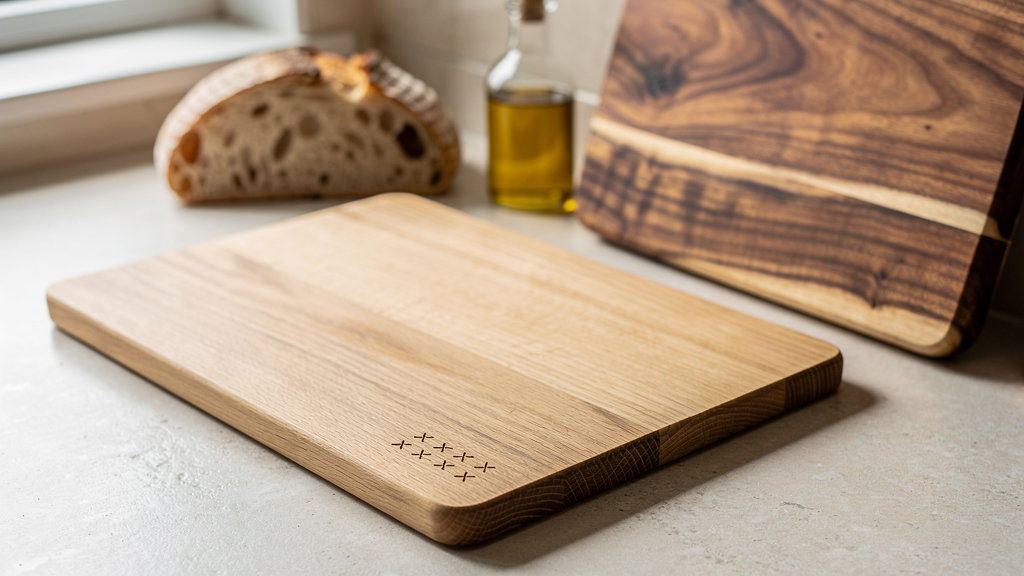
Our personalised solid oak chopping board measures 27 × 12.5cm and is currently £12.99. That is about 338cm² of surface. It takes a loaf and a wedge of cheese comfortably. It does not take an onion and a chicken breast with room to work. Think of it as a bread board, a small serving board, or something that lives on a counter or shelf with a name on it.
The personalised acacia serving board comes in medium (300 × 200mm, currently £13.99) and large (400 × 300mm, currently £16.99). Medium is 600cm², roughly one and three-quarter times the oak board. Large is 1,200cm². Per square centimetre, the large acacia is the cheapest of the three sizes by a wide margin: about 1.4p against 3.8p for the oak.
We list the acacia as a serving board, and that is the accurate description. It will take light chopping. We would keep the heavy knife work for a plain board and let the engraved one do the serving. In our experience an engraved board becomes the one people put out, not the one they cut on.
A laser engraves wood by burning it, so what you see is the wood's own reaction. Density, resin and grain decide how dark the mark comes out and how fine the lettering can be.
Oak is dense and fairly even. The engraving comes out as a clean brown mark against a lighter ground, and fine lettering holds its edges. The grain runs through the full depth of the board, so there is no veneer to sand through. Oil darkens the surrounding wood, which tends to narrow the contrast between mark and board a little after the first oiling. It does not erase it.
Acacia is the more varied wood. Colour runs in bands from pale honey to dark brown, and the same lettering reads differently depending on where it lands. A dark band can swallow fine type. We can't preview where the grain will fall on a particular board before cutting, so plain, short wording is the safer choice. The board is finished with food-grade oil rather than lacquer, so there is no coating to chip at the edge of the lettering. The trade-off is upkeep: it needs re-oiling when it starts to look pale or dry.
Bamboo is a grass, and a bamboo board is strips of it glued together. It engraves evenly, but the glue lines run through the board and can show as faint lines across lettering. We don't currently make a bamboo chopping board. The bamboo we engrave is small pieces: keyrings, bottle openers and a 175 × 86mm tray, none of which is a chopping surface. If bamboo is your choice for sustainability reasons, we would rather say so than steer you to a different wood. Our piece on sustainable engraved gifts in bamboo and cork covers what we do make.
Both woods are finished with food-grade oil, not a sealed coating, and that shapes how they age. An oiled board that is wiped and dried after use darkens slowly and evenly. A board that is left damp, or loaded with oily food overnight, stains where the food sat. The engraving itself is cut into the surface, so it does not peel the way a printed design can. What does wear is the wood around it. A board used daily will round off and mark at the edges first, and an engraved area that takes regular knife work will soften over a year or two. That is the real limit of any engraved chopping board, and it is the reason we steer people towards using theirs for serving.
If the board is a gift for someone who uses their kitchen hard, the oak is the more forgiving of the two to live with, because its tone is even and a scratch is less noticeable. If it is a gift for a table, the acacia has more to look at.
For a wedding or anniversary, medium acacia with two first names and a date. It is large enough to be used for serving and sits well on a shelf afterwards. Our guide to what to engrave on a wedding chopping board goes through the wording.
For a housewarming or a first flat, the oak board. It is compact, it fits a small kitchen, and a surname and a year is enough.
For someone who bakes, oak again. A 27cm board is the right length for a loaf.
For someone who hosts, large acacia. If the aim is a spread for six or more, see our comparison of grazing boards and chopping boards before choosing.
Browse the full range in personalised wooden and bamboo gifts.
Standard personalised orders are processed within 1–3 business days of the personalisation being confirmed. Production starts when the wording is confirmed, not when the order is placed. UK delivery then takes an estimated 2–4 business days after dispatch, by Royal Mail, DPD or EVRI. Nothing is processed, dispatched or delivered at weekends or on UK bank holidays. Delivery times are estimates, and tracking details are emailed when the order is dispatched.
In the longest case that is seven working days from confirmed wording to your door. For a Christmas board, count back seven working days from the date you need it, then add a margin for peak-season carriers and any wording changes. We explain why December gets tight in why ordering early matters.
Oak for a small, solid board with a name on it. Medium acacia for a wedding or anniversary. Large acacia for hosting. No bamboo board from us. Keep the wording short, wash by hand, oil when it looks dry, and keep the knife on a plain board.
Choose your wood and add your wording on the personalised oak chopping board or the personalised acacia serving board.