Total: £0.00
Taxes and shipping calculated at checkout

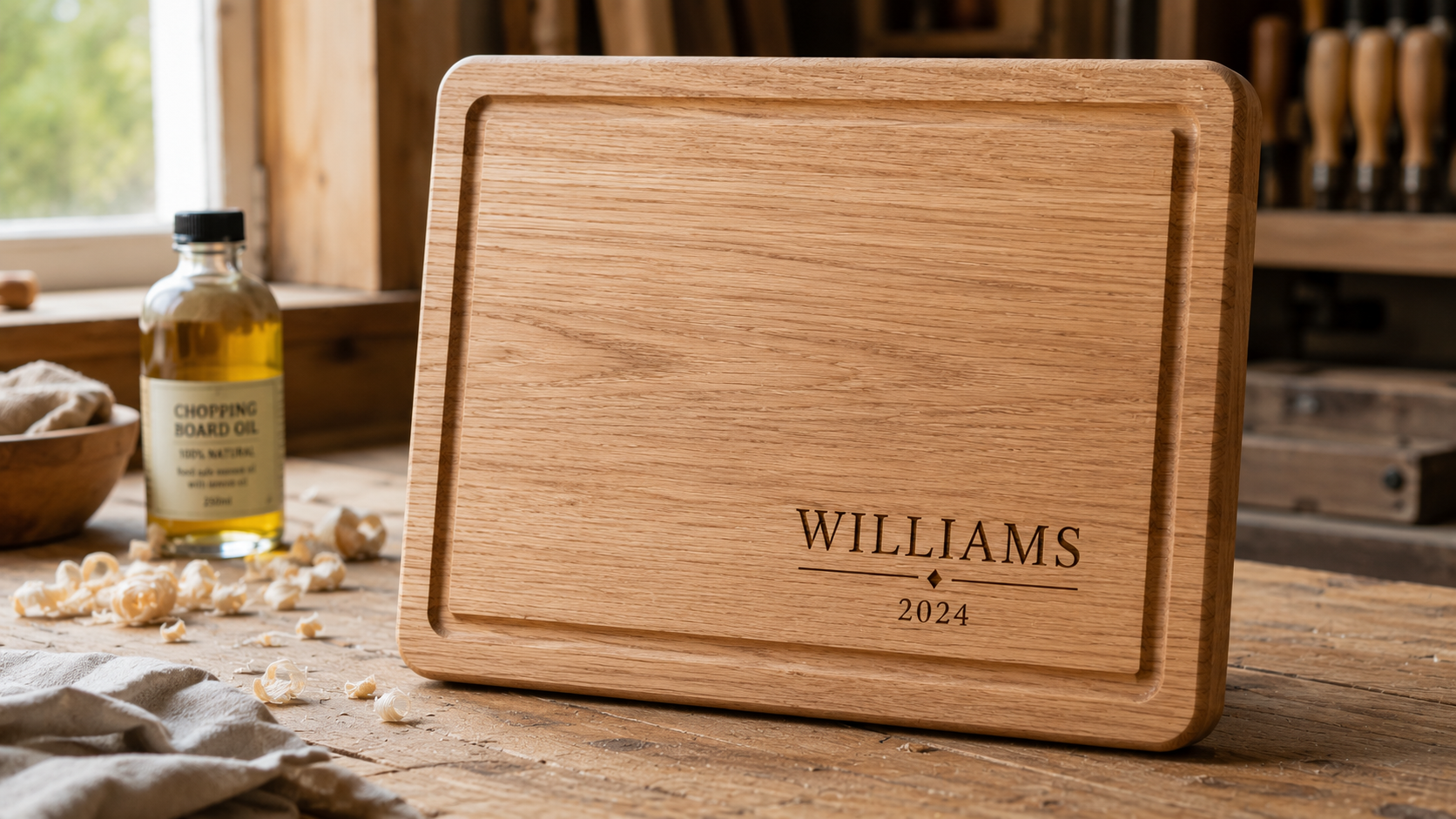
Most wedding presents get opened once, admired, and absorbed into a house. An engraved wooden wedding chopping board gift tends to go a different way. It ends up on the worktop, in daily use, with two names on it that mean something. We engrave a lot of them in our workshop, and the difference between a board that gets used for a decade and one that gets quietly retired is almost never the wood. It's the brief.
So this is a guide to writing that brief. What couples actually ask us to engrave, what the laser holds cleanly at depth, and where the design should sit so it survives ten years of Sunday dinners.
Wedding gifts have a duplication problem. Three toasters, two kettles, a stack of vouchers. A board engraved with the couple's names can't be duplicated, returned, or regifted — it belongs to exactly two people from the moment the laser finishes.
It also earns its place physically. Solid wood boards take daily chopping without marking badly, and because the engraving is burned into the timber rather than printed on it, the names don't wash off, peel, or fade. The board gets better-looking as it wears in. Most decorative wedding keepsakes go in a drawer within a year. This one gets reached for.
The timing is flexible too, which makes it a forgiving present to plan. We engrave boards for engagement parties, for the wedding itself, and for first anniversaries — and because wood is the traditional fifth anniversary material in the UK, the same gift works five years later with a different date on it. Very few wedding presents can be given at four separate points in a couple's life without changing anything but the engraving.
A word on timber, since it affects how the engraving reads. Oak is dense and even, so text comes out crisp and dark against a pale surface — the traditional choice, and the safest. Acacia runs warmer, with amber tones and visible grain movement that suits larger serving-style boards. Bamboo is the lightest and most affordable, and engraves with strong contrast, though it reads more everyday than heirloom. For a wedding, we'd steer towards oak or acacia; the extra weight in the hand matches the weight of the occasion.
Briefs for a wedding board fall into a few recognisable patterns. These are the ones that come through our workshop most often, and why each works.
The most ordered layout, by some distance: a surname above the wedding year. The Harrisons — est. 2026. It works because it's short enough to read from across a kitchen, it suits a confident serif, and it marks the thing the wedding actually created — a new household. If the couple are keeping separate surnames, the same layout works with both names and an ampersand.
Amira & Daniel — 12 September 2026. More personal than the surname layout, and the one to choose when you know the couple by their first names rather than as "the somethings". A detail worth knowing: an ampersand engraves more cleanly than the word "and" at small sizes, because its single connected stroke holds depth better than three separate letters.
The Osman family kitchen. For couples who already cook — the ones whose wedding present should acknowledge where they actually spend their evenings. This layout suits a larger board that will live on the counter as a serving piece as much as a cutting surface. Our personalised acacia wood serving board takes this style particularly well; the grain variation gives the text something to sit against.
A fragment of a vow, a line from the first dance, the words on the order of service. These make the most personal boards we produce, with one caveat: keep it under about eight words. Engraved text is read at a glance, not studied, and a long passage forces the letter height down to where it stops reading as a statement and starts reading as small print.
A quieter option that's grown steadily in our order book: the coordinates of the venue, or of the place they met, engraved small in one corner. 51.5072° N, 0.1276° W. It reads as a private reference rather than an announcement — guests see numbers, the couple see the registry office. Coordinates also engrave beautifully, for the same reason dates do: numerals are geometrically simple and hold their shape at almost any size.
This is the part most gift guides skip, and it's the part that decides whether the board still looks sharp in five years.
When we engrave to around 3mm of depth, the burn goes past the surface fibres and into the body of the timber. That's what makes the mark permanent — washing, oiling, and knife work take place above it. But depth has rules. What survives it:
And what doesn't:
If you're unsure whether a design will hold, send it over before ordering. We'd rather adjust a layout than engrave one that won't wear well.
Placement gets less attention than wording and matters nearly as much. The centre of the board is the working area — it's where the knife lives, and any engraving there will be crossed by cut marks within weeks.
The layouts that age well keep the text out of the knife's way: the lower third for a wide landscape design, a corner for a compact monogram, or along the handle if the board has one. Run the text with the grain rather than across it, and the letterforms stay crisp because the laser isn't fighting alternating bands of hard and soft timber.
There's a practical bonus to corner and edge placement: when the board hangs or leans against the splashback between uses, the names face the room. The board does its job twice — cutting surface on weekdays, quiet statement the rest of the time.
A question we're asked most weeks: should the couple cut on the engraved side? They can — the depth means the design survives it — but most treat the engraved face as the display side and chop on the reverse. It's the arrangement we'd suggest. The board stays fully functional, the engraving stays clean, and nobody has to feel precious about using a wedding present for its actual job. If the board will be used mainly for serving — bread, cheese, a Saturday spread — then the engraved side faces up and earns its keep in front of guests.
If the gift is going to carry a wedding date, it's worth including a line about care in the card — most couples aren't told, and it takes two sentences. Hand wash, never the dishwasher; heat and detergent are what split wooden boards, not knives. Once a month or so, a coat of food-safe mineral oil or board butter, wiped on and left overnight.
The oil deepens the engraving's contrast as well as protecting the timber, so the names actually become more legible over the first year of use. A board treated this way outlasts most of the appliances bought off the same gift list.
When you order, this is all we need:
A complete brief, as it might arrive in our inbox: "Surname layout — The Ahmed family, est. 2026. Serif, lower third, running with the grain. It's for their wedding on 22 August, so we'd like it in hand the week before." Four decisions, two sentences, and everything the workshop needs to get it right first time.
Double-check the spelling of both names and the date before it goes in the basket. Engraving at depth is permanent — that's the point of it — so the details deserve one careful read before we burn them into oak.
A board is also a strong anchor for a larger wedding gift. Ours sit alongside the rest of our personalised wooden gifts, and if you're building a gift around the day itself, the personalised celebration gifts collection covers the pieces that mark the occasion rather than the kitchen.
For couples who host, add our personalised cheese knife set to turn the engraved board into a coordinated serving gift.
Add your engraving details at checkout and we'll take it from there.