Total: £0.00
Taxes and shipping calculated at checkout
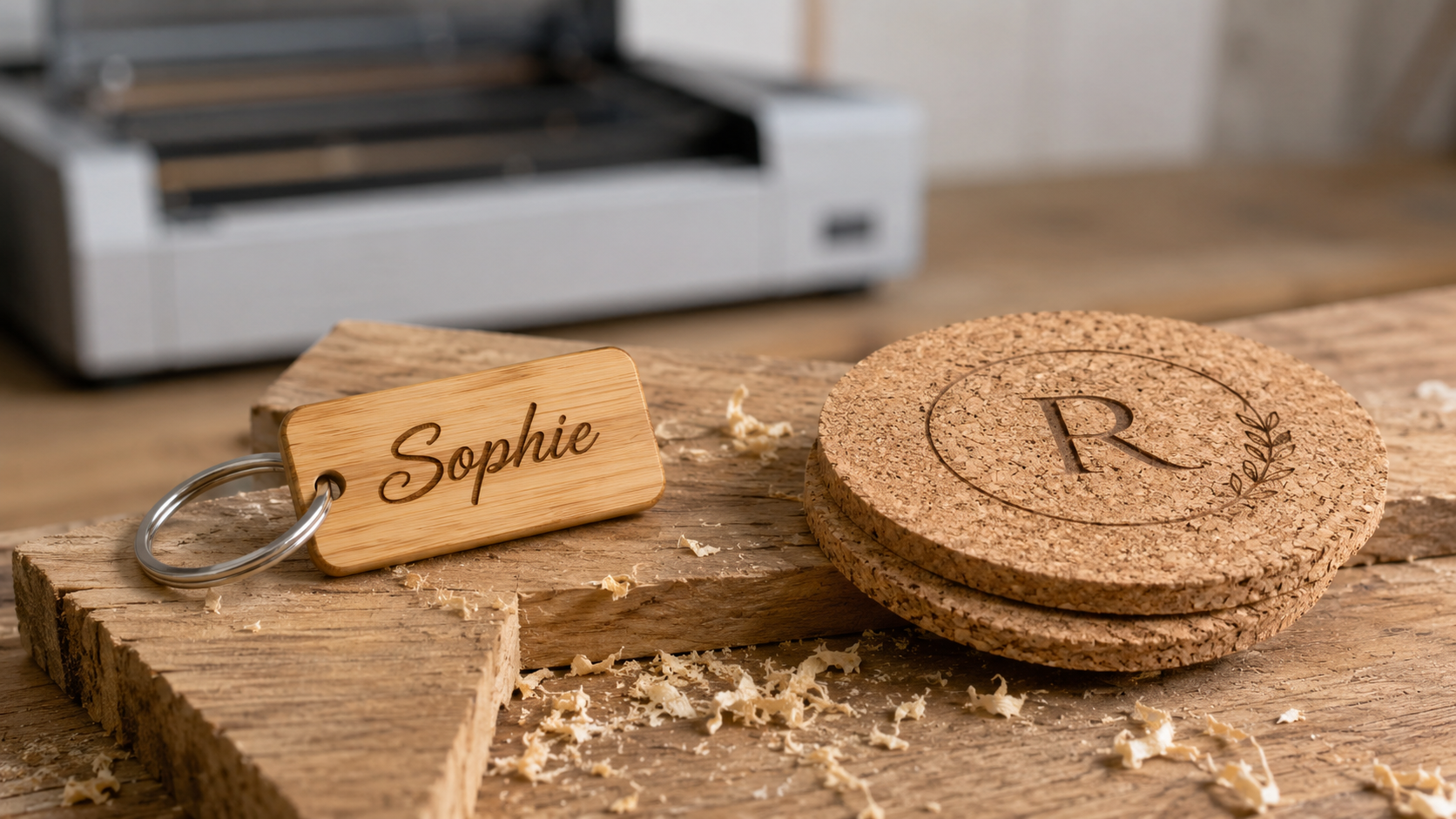
Sustainable engraved gifts made from bamboo and cork get lumped together as "eco" without much explanation of what that actually means. We work with both materials every week at the bench, and once you put a laser to them, they have almost nothing in common.
Bamboo behaves like a tight-grained hardwood. Cork behaves like nothing else we engrave. Knowing the difference matters if you're choosing a gift and want it to hold up.
The word gets used loosely across gift sites, so here's what's actually true of bamboo and cork, without dressing it up.
Bamboo is ready to harvest in three to five years. Oak takes decades. The plant regrows from the same root system after cutting, so there's no replanting cycle and no bare hillside waiting to recover. That's the genuine advantage: speed of regrowth, not a vague claim about being "green".
Cork comes from the bark of the cork oak, stripped by hand roughly once every nine years. The tree isn't felled. It keeps growing, and a single cork oak can be harvested for well over a century. The material in a set of coasters came off a tree that's still standing in Portugal or Spain.
Neither fact makes bamboo or cork automatically better than oak or slate for every gift. It makes them better for specific things, which is the part most "eco gift" roundups skip.
This is where the two materials properly separate, and it's what actually decides what we'll recommend a design for.
Bamboo's fibres run tight and uniform, so the laser burns a crisp, dark line against a pale surface. Fine script, small initials, thin logo lines. Bamboo holds all of it. It's why our personalised bamboo keyring can carry a full name in a space smaller than a fingernail and still read clearly at arm's length.
The trade-off is weight. Bamboo veneer used in trays, notebook covers, and pen sets is deliberately lightweight, so it's not the material to choose if someone wants something substantial and heavy in the hand. That's oak's job.
Cork is soft and full of tiny air pockets, so the laser doesn't cut a clean line the way it does on bamboo. The burn sits shallower and the contrast is softer: a warm brown against tan, rather than sharp black against pale wood. Fine script can blur at small sizes.
Bold lettering, simple monograms, and single-line icons come out sharp every time. That's the brief we set ourselves whenever we're engraving a set of personalised cork coasters: keep the design bold and it holds. Ask cork to do what bamboo does, and it won't.
Neither material is right for everything, and we'd rather say that plainly than push bamboo or cork somewhere oak or slate would serve someone better.
Keyrings, pen and notebook sets, serving trays: bamboo works because these are light-use, light-touch items that travel in a pocket or bag. It's not what we'd reach for on a chopping board that sees a knife every day. Oak holds an edge and a scrub better over years of that kind of wear.
Cork's structure pulls moisture away from the surface beneath it instead of letting a ring sit and mark the wood underneath. That's a real, functional reason to choose cork for coasters. It isn't a general reason to choose cork for anything that happens to need engraving. The material's softness works against it almost everywhere else.
Customers usually land on bamboo or cork for one of two reasons: the recipient cares about sustainability, or the price point suits a smaller gift or add-on. Both are good reasons, and each material fits a different kind of request.
Businesses ask for bamboo pen and holder sets and bamboo notebook and pen sets more than anything else in this category. A logo engraves cleanly, the unit cost stays low for large quantities, and it photographs well on a desk. We quote production time individually for bulk orders once we know quantity and design.
Cork coasters turn up in this pile constantly, usually alongside a slate or wooden item rather than on their own. A set of two at £3.99 works as a small addition to a bigger gift; a set of six makes a fuller present on its own.
The bamboo keyring is the one we engrave most often across birthdays, thank-yous, and small Father's Day gifts. At £1.75 it's an easy add to a larger order, and the initials or short name stay legible for years of use.
Bamboo wipes clean with a damp cloth. It shouldn't go in a dishwasher or sit waterlogged in a sink. A bamboo tray left wet for hours can warp, the same as any timber. A drop of food-safe oil once or twice a year keeps the surface from drying out and stops the engraving from looking chalky.
Cork is more forgiving with moisture and less forgiving with pressure. A hot mug straight off the kettle is exactly what it's built for. A dragged glass or a dropped set of keys will leave a mark, because cork compresses rather than resists. Neither of these is a flaw we'd hide in a listing. It's just what the material is, and it's worth knowing before it turns up under a drink for the first time.
All personalised orders, bamboo and cork included, are processed within 1–3 working days once the engraving details are confirmed.
The regrowth rate is genuinely fast, and that part holds up. What we won't claim is that a bamboo keyring has some measurable carbon saving over a wooden one, because we haven't seen data that would let us say that honestly. What we can say is that the plant regenerates without replanting, which oak, walnut, and most hardwoods don't do on any comparable timescale.
No. Cork's air pockets are what make it good at pulling moisture away from a worktop, but that same structure means it doesn't cope well with prolonged heat and pressure in a dishwasher cycle. A wipe with a damp cloth is enough, and it dries in minutes on its own.
Laser engraving burns into the surface rather than sitting on top of it, so it doesn't peel or rub off the way a printed or stamped design can. Bamboo holds its contrast for years with normal handling. Cork's softer burn can shallow out slightly faster under heavy daily use, though a coaster used for the odd cup of tea will look the same in five years as it does on day one.
It depends what they'll actually use. Someone who wants a keyring, notebook, or desk item gets more daily use out of bamboo. Someone who needs coasters gets a material that's doing a genuinely better job than most alternatives at that specific task. Neither is the "more sustainable" choice in the abstract. It's about matching the material to what gets used.
We keep working in bamboo and cork alongside oak, slate, and acrylic because each material earns its place for a specific reason, not because "eco" sells better on a product page. Bamboo regrows fast and takes fine detail. Cork comes off a tree still standing and does one job, coasters, better than anything else we stock.
Browse our wooden and bamboo gifts to see where the two end up.