Total: £0.00
Taxes and shipping calculated at checkout

Nine times out of ten, the coordinates arrive with too many decimal places. A customer drops a pin on Google Maps, copies the string straight out of the address bar, and pastes eight digits after the decimal point into the personalisation box, enough precision to locate a single blade of grass, not a house. We round it before it goes anywhere near the laser, and we tell them why.
A leather engraved keyring with coordinates on it is a small object carrying a specific place: where someone proposed, where a first flat was, where a hospital ward became a memory that gets mentioned every birthday after. Getting the number right matters more on this product than on almost anything else we cut.
The requests follow a pattern once you've seen enough of them. A father ordered one with the coordinates of the maternity ward where his daughter was born, engraved the week he found out he was becoming a grandfather. A woman ordered two, matching, for her and her now-husband, with the coordinates of the beer garden where he proposed, not the restaurant they'd booked for afterwards. A customer serving overseas ordered one with the coordinates of an airport departure gate, for the partner staying behind.
None of these are addresses in the postal sense. They're pins on a personal map. That's the appeal of coordinates over a name or a date: a date can belong to anyone who shares a birthday, but a six-decimal pin belongs to exactly one patch of pavement.
We see a smaller, steadier stream of a different order too: businesses engraving the coordinates of a head office or a first shop premises onto keyrings for staff milestones and client leaving gifts. It's the same logic in a corporate register: a location that means something to the people getting it, rather than a logo everyone's seen a hundred times. Get in touch directly for that kind of order; anything over a handful of pieces is priced and timed separately from a single personalised keyring.
Two formats exist and they are not interchangeable on a laser bed this size. Decimal degrees look like 51.5074, -0.1278. Degrees-minutes-seconds look like 51°30'27"N, 0°07'40"W. The second format runs roughly a third longer once you add the seconds, and on a keyring this size that's the difference between a clean two-line engrave and text that has to shrink past the point we're comfortable stamping our name to.
We ask for decimal degrees, rounded to four decimal places. Four decimal places resolves to around 11 metres on the ground: close enough to mean a specific bench, doorway, or gate, while staying short enough to sit cleanly on 95mm of faux leather. Six or seven decimal places, which is what a phone's GPS app hands you by default, is more precision than the engraving needs and more characters than the keyring has room for.
The other detail people miss: the minus sign. Anywhere west of Greenwich or south of the equator needs a negative number, not a compass letter, if you're giving us decimal degrees. Drop it and the coordinates point to a different hemisphere. We catch this most weeks and query it before cutting, but a customer who spots it themselves saves a day.
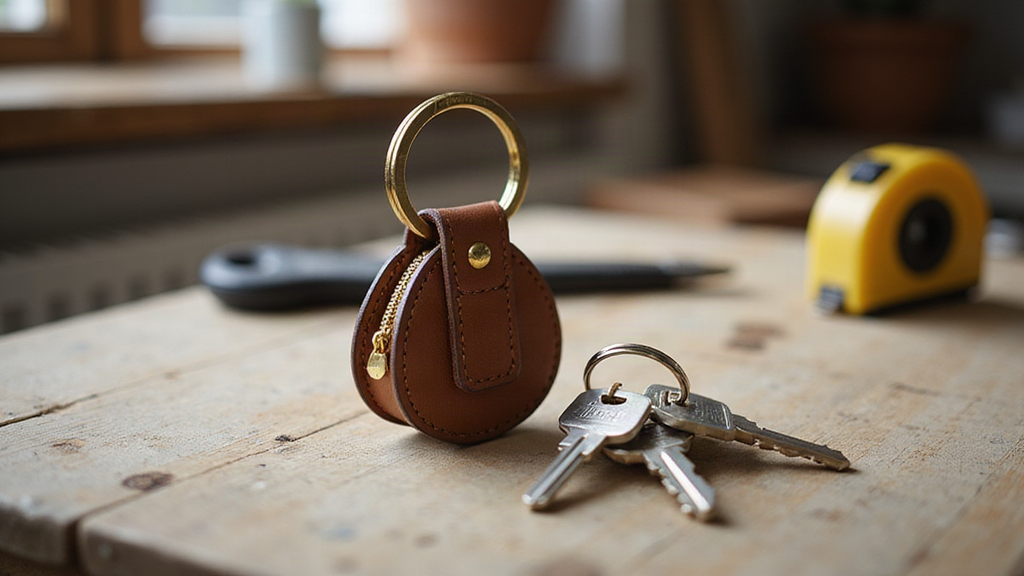
The personalised leather keyring is 95mm by 17mm, made from PU leather rather than a hide. We say faux leather on the product page and we mean it. It's not a full-grain leather good sold as something it isn't. What it does well is take a laser cleanly: the engraving works by lightening the coating rather than burning through it the way a wood or bamboo surface does, which is why the lettering reads as pale grey against black or brown rather than a scorched line.
The usable engraving area, once you allow for the edge margin and the hole for the ring, is closer to 70mm by 11mm. Two lines of coordinates at a legible size uses most of that. A third line, a name above the numbers, say, is the point where legibility starts to suffer, and we'll flag it rather than run it anyway. If someone wants a name and a full set of coordinates, we usually suggest the wider wooden keyring, which gives more surface to work with.
One more limitation worth stating plainly: we engrave the numbers we're given. We don't check them against a map before cutting. If a customer pastes the wrong pin, or copies coordinates for the general Google Maps view rather than the dropped marker, that's what goes on the keyring. We'll ask if a set of numbers looks obviously malformed, but verifying that a pin sits on the right doorstep isn't something we can do from a workshop bench.
The gold-toned hardware is worth a word too. It holds up well against everyday use: keys, a bag clip, a pocket. But it's a plated finish, not solid brass, and after a couple of years of daily knocking against a bunch of house keys it can start to show at the edges where the plating is thinnest. That's normal wear on a £3.99 keyring, not a fault, but we'd rather say it now than have someone surprised by it later.
The most common fix requests we handle, in order of frequency: too many decimal places submitted, which we round down ourselves once we've confirmed the customer is happy losing that precision; a missing minus sign on a western or southern coordinate; degrees-minutes-seconds format sent for a two-line layout that only has room for decimal degrees; and a screenshot of a map sent instead of typed numbers, which means retyping from a photo and the small risk of a transposed digit that comes with it.
The other pattern is emotional rather than technical: people ask for two locations on one keyring, where they met and where they married, say, and there genuinely isn't room. We'd rather say so before the order goes to production than deliver something with six-point type nobody can read at arm's length. Occasionally a customer asks for a compass bearing or an elevation figure alongside the pin; both are the kind of extra detail that reads clearly on a house sign and disappears on something this size, so we'll usually suggest cutting it.
Standard personalised orders are processed within 1–3 business days once the personalisation details are confirmed. That clock starts when we have clean, complete engraving text, not when the order lands. A set of coordinates that needs a back-and-forth to fix the format pushes the start of that window back by however long the email takes to answer. Sending decimal degrees, rounded to four places, with the minus sign where it's needed, means production starts the same day the order comes in. Delivery after dispatch runs 2–4 business days within the UK via Royal Mail, DPD, or EVRI depending on the order.
The fix is almost always the same: open the map, long-press or right-click the exact spot rather than trusting whatever the address bar shows, copy the decimal pair, and trim it to four places after the point before it comes to us.
A coordinates keyring only works if the numbers are right, which is a smaller ask than it sounds and a more common mistake than you'd expect. Get the format right and it's a same-day production job. Personalise the leather keyring above, or get in touch first if you're not sure your pin is precise enough to engrave.