Total: £0.00
Taxes and shipping calculated at checkout

Most branded keyring enquiries start life as a JPG. Someone has lifted a logo straight off the company website, sized however a browser happened to render it, and attached it to an email asking for fifty by Friday. Getting from that file to a batch of branded engraved keyrings for businesses that all read as the same company is most of the actual work, and it happens before the laser is switched on.
This is what we ask for when a business orders keyrings in bulk, why some of the fine print on a logo has to go, and how the price genuinely moves as the quantity does. It also covers where these orders go wrong, because nearly all of it is avoidable if it's caught before a batch runs rather than after.
A vector file is what we ask for first: an .ai, .eps, .svg, or a PDF saved out of vector software. It scales to any size without losing an edge, which matters more on a keyring than almost anywhere else a logo appears, because the finished mark is often under 3cm across. A JPG or PNG pulled from a website is built for a screen at a fixed size. Blown up or shrunk, its edges soften and its finer lines start to break up under the laser.
If a vector version genuinely doesn't exist, we can trace a raster logo into an engraving-ready line file. We say so upfront rather than run it and hope. A traced logo is an approximation of the original, not a reproduction of it, and that's worth knowing before fifty keyrings are cut, not after.
Laser engraving reads in line and depth, not colour. A gradient, a drop shadow, or a mark built from three brand colours all reduce to a single tone once engraved. Most brand guidelines include a simplified, single-colour version of the logo for exactly this kind of use, and that's the file to send, along with confirmation of any wording that sits alongside the mark. A business name set differently to the website version is one of the easiest things to get wrong on a rushed order.
Personalising a name is forgiving. A name can lose a little sharpness at the serif and still read as that name. A logo doesn't get the same leeway, because it's judged against itself: the version on the website, the version on the van, and the version on the keyring all have to look like the same mark.
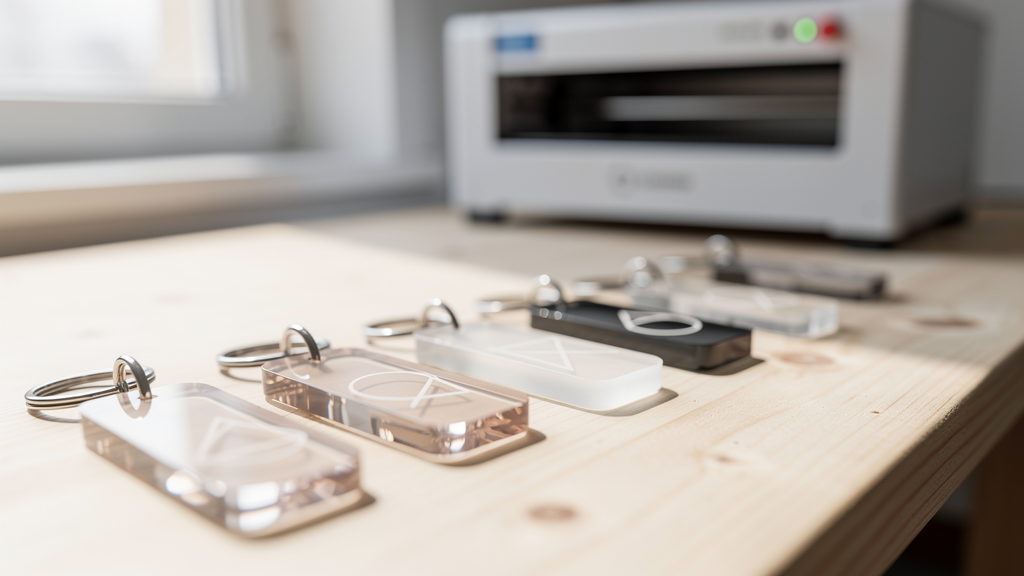
Acrylic holds the crispest result. It's cut and engraved rather than burned, so a fine line stays fine and small text stays legible down to around 2.5mm cap height, which is roughly our practical floor before detail starts to blur. Our custom NFC acrylic keyring with an engraved logo is built around this: a flat, grain-free surface for the mark, with an NFC chip underneath so the keyring also works as a tap-to-link digital card.
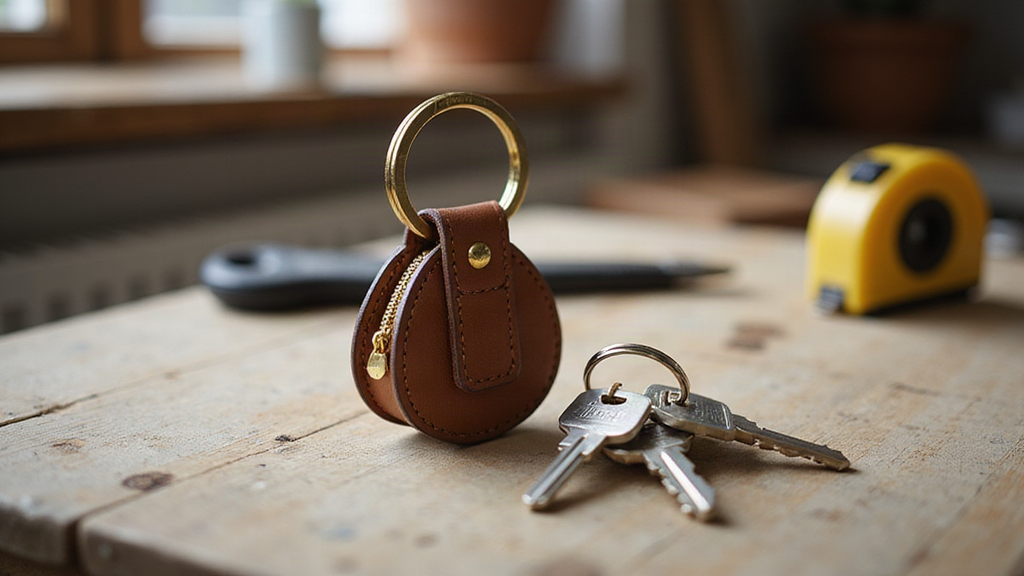
Wood and bamboo engrave warmer, but the grain interrupts very fine strokes. A bold icon or a thick wordmark holds up better than a delicate script logo. Our personalised wooden keyrings suit a simpler mark or a company name set in a solid typeface well. Leather sits between the two: it chars a little darker at the engraved edge, which deepens the contrast on a solid mark, but hide grain and colour vary piece to piece. No two keyrings from the same leather batch will be perfectly identical. That's a property of the material, not a fault in the run, and worth knowing before fifty go out with a client's name on them.
There's no published price list for corporate quantities, and that's deliberate rather than an oversight. Two things drive the cost: the material and laser time per piece, and the fixed setup of loading the file, positioning the jig, and running a test piece to check the mark before the batch runs. That setup cost is the same whether the order is for ten keyrings or two hundred, which is why the price per unit drops as quantity rises. It isn't a volume discount in the retail sense. It's one fixed cost spread across more pieces.
Individually, our engraved keyrings start from £2.45 for the wooden range and run to £4.99 for the NFC acrylic version. A bulk quote on the same design comes in below that per unit once quantity clears the point where the setup stops dominating the price, which is usually somewhere past a few dozen pieces depending on how much preparation the logo needs. Send the file and the number required and we'll come back with a figure, not a bracket.
Three patterns account for most of the problems we see.
The first is ordering to exact headcount. Personalised items aren't returnable, and a batch runs as one job, so there's no quiet reprint if a keyring goes missing between the box and the desk it was meant for. A small buffer over the number of recipients costs little set against a second setup run later.
The second is sending the logo after the quantity's already agreed, or sending a version with a strapline that reads fine on a laptop and disappears once it's shrunk to keyring size. Fine print under around 2.5mm cap height rarely survives the engrave, particularly in wood grain, so it's worth deciding early whether the mark travels alone or with a tagline attached.
The third is assuming a digital proof and the finished object will match exactly. A mockup shows layout and proportions. It won't show how a particular leather dye lot takes the char, or precisely how dark an acrylic engrave reads under office lighting versus the photo it was approved from. For any batch large enough to matter, we run one physical sample before the rest. That adds a day, and it's a day we'd rather add than have someone open a box of fifty to find the mark darker than expected.
A standard personalised order is processed within 1-3 business days once the personalisation is confirmed. A bulk or corporate order doesn't run on that same clock. The timeline is quoted individually once we've seen the logo and the quantity, because a fifty-piece single-material run and a two-hundred-piece mixed order aren't the same job, and we'd rather confirm a real date at enquiry than promise one before we've seen the file.
Once dispatched, standard UK delivery runs 2-4 business days via Royal Mail, DPD, or EVRI, depending on order size and destination. Neither processing nor delivery happens over a weekend or a UK bank holiday, so a keyring order tied to a specific date, an onboarding day, a conference, a product launch, needs that lead time built in from the enquiry, not from the day the order goes in.
The full range of corporate and branded pieces, keyrings included, sits in our corporate branding collection.
A branded keyring is a small object carrying a business's whole visual identity into someone's pocket. Getting the file right does more for the result than anything we do with the laser afterwards. Send the logo and the numbers. We'll tell you what it will look like, what it will cost, and when it will land.