Total: £0.00
Taxes and shipping calculated at checkout

A personalised water bottle kids actually use is the one that comes home. Not the one bought in August with good intentions, then left in the PE cupboard by October half term. We see the same pattern every back-to-school season: a parent orders two or three bottles for one child because the first one didn't survive a fortnight in a school bag. The bottle itself is rarely the real problem. Either the name wasn't permanent, or the build wasn't right for how a seven-year-old actually treats it — dropped in on top of a lunchbox, left open in a side pocket, kicked under a coat peg on the way out the door.
Named items come back. Unnamed ones sit in lost property until someone finally empties the box at the end of term. That part's obvious. What's less obvious is that a name in marker pen, or printed on a sticker, doesn't survive contact with a dishwasher, let alone six weeks in a school bag. It fades at the edges, peels at the corner, or gets scrubbed off along with the crayon marks a five-year-old adds for good measure.
Engraving doesn't have that problem, because it isn't sitting on the surface. It's cut into the metal itself, so there's nothing for a dishwasher cycle, a wet wipe, or a determined thumbnail to lift.
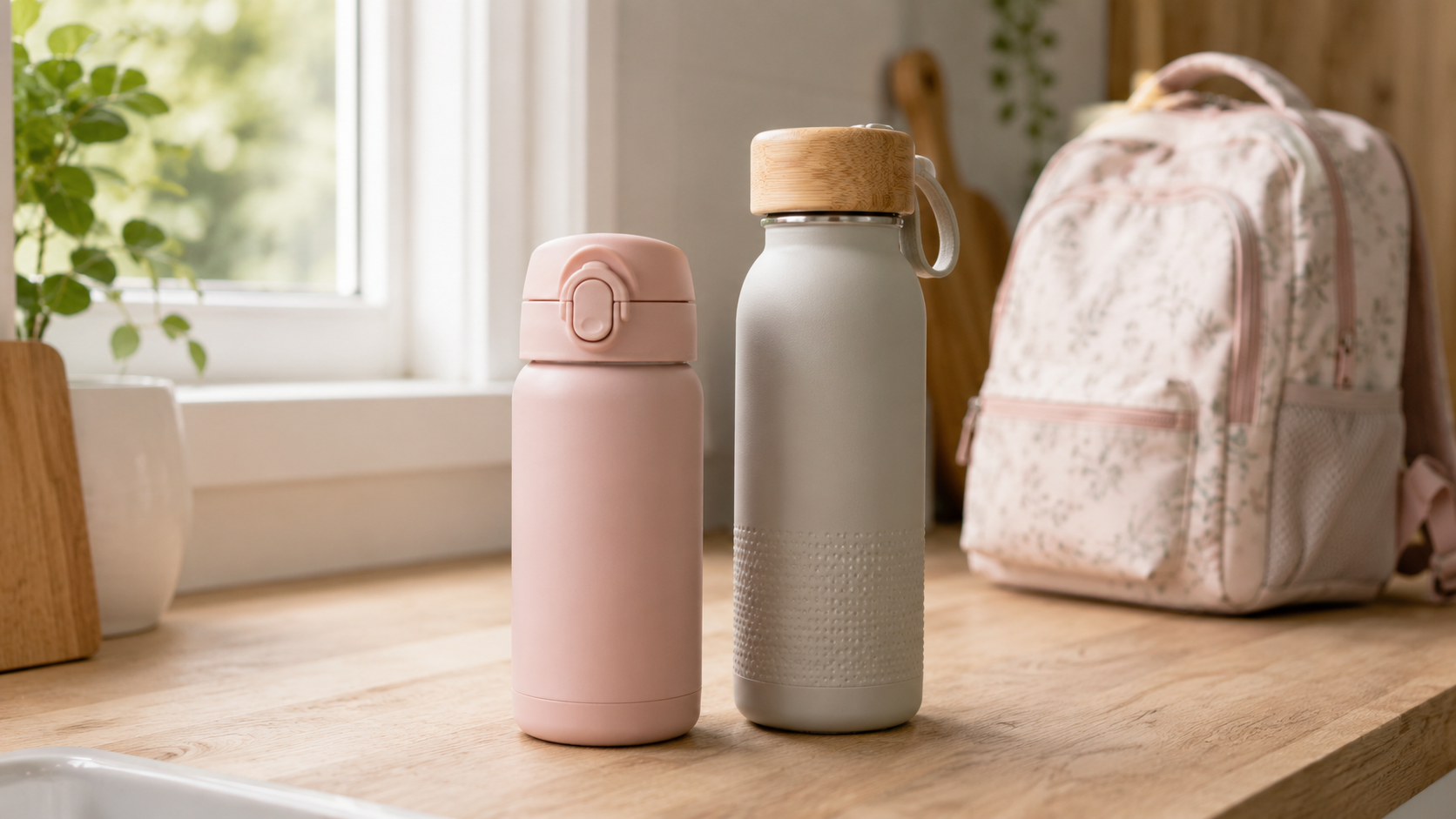
We stock two kids' bottles that get reordered term after term, and they're built differently on purpose. A reception child and a year 5 child put very different demands on a bottle.
This is the smaller of the two, and it's solid stainless steel from body to lid: no bamboo, no separate silicone sleeve, nothing that can crack off on its own. For nursery and early primary years, that one-piece build matters more than capacity. Younger kids drop things, often, and a flip-top lid with no detachable parts means there's nothing extra to lose in a bag. The whole personalised kids water bottle can go through a dishwasher without worrying about a wooden or rubber piece swelling or splitting apart. It comes in four colourways: Bright Pink, Purple, Yellow, and Sky Blue. The name sits across the body rather than the lid, so it stays legible after the flip-top's been opened and shut a few thousand times.
This is the one that moves up with older kids: more capacity, a matte rubber body that survives being dropped on tarmac without denting, and a bamboo lid instead of an all-metal one. The bamboo lid is lighter to twist open with smaller hands, and it doesn't get anywhere near as hot in direct sun as an all-metal cap would on a July sports day. It isn't dishwasher-safe in quite the same way as the stainless lid, because bamboo doesn't get on with sustained heat and moisture. This is a hand-wash-the-lid, dishwasher-the-body bottle. Worth knowing before ordering it for a child who's expected to empty their own dishwasher rack.
Not marketing language — the specific things that break bottles during term time. Drop height off a coat peg. A bag left standing up on a bus, then knocked over. Whether the engraving still reads clearly after weeks of being wiped with a wet wipe rather than properly washed. Whether the lid seals well enough that the bottle can go in sideways next to a lunchbox without leaking through the whole bag.
Both stainless builds hold their engraving and their seal through all of that without issue. The part we watch most closely is the lid mechanism, because flip lids get more daily use than screw lids. That's where a cheaper bottle usually fails first. Ours are built with that specific stress in mind, not a showroom shelf.
We get asked for one most often around the autumn eco-gifting push, and we've stuck with the same answer: bamboo makes a good lid, but a poor full bottle for a child who uses it daily. A lid gets a quick twist and a splash. A full bottle body sits wet inside a bag for hours, gets refilled with warm squash, goes through a dishwasher on a hot cycle, and gets dropped on concrete more than once a term. Wood-based materials swell, dry unevenly, and eventually hairline crack under that kind of repeated wetting and drying. Slate and solid oak handle it fine on a chopping board or a coaster, where they're wiped rather than submerged, but a drinks bottle is a different job entirely.
That's why the bamboo on the 750ml bottle is limited to the lid, where it earns its place — lighter, cooler to the touch, and not doing the heavy lifting the stainless body handles instead. Stainless steel is the material that actually survives a school term as a full bottle. Bamboo, on this product, is the detail that makes it nicer to use, not the thing holding it together.
The 350ml suits nursery through to around year 2: small enough for smaller hands, no separate parts, easy for a teacher to help with at home time. The 750ml suits juniors and up, where the extra capacity covers a full school day plus an after-school club, and where a child can manage a bamboo lid without help.
If we had to pick one bottle for a household with more than one child, we'd size to the youngest and let the older one carry the 750ml. An older child adjusting down to a smaller bottle is a much easier problem than a five-year-old struggling with one built for someone twice their age.
Half of what we hear about a bottle "not lasting" is actually a packing problem rather than a build problem. A bottle stored upright, in its own pocket, away from a PE kit zip or a pencil case corner, takes far less daily damage than one loose at the bottom of a bag with everything else on top of it. Flip lids in particular do better closed properly rather than pushed shut in a rush at the school gate — a lid that isn't fully seated is the most common reason a "leak-proof" bottle leaks. None of this is complicated, but it's the difference between a bottle making it to July and one that's cracked by Halloween.
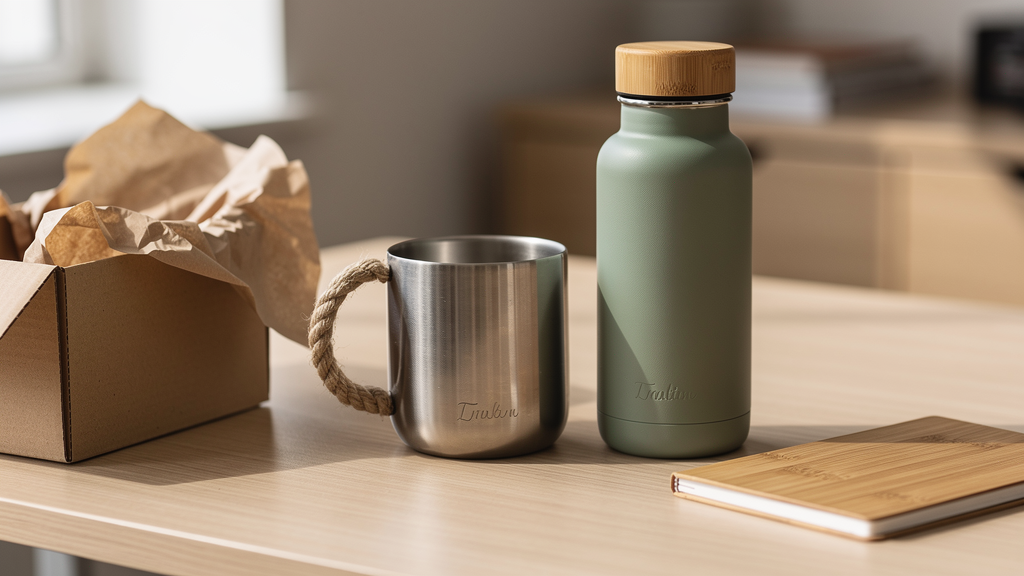
We laser engrave the name directly into the metal, not onto a printed label or a vinyl sticker. That's the difference between a name that survives September and one that needs replacing by half term. Placement is set to sit clear of the lid seal and away from the base, where most of the scuffing happens when a bottle gets set down hard on a table or a classroom floor.
We keep personalisation to a first name, or a first name with a surname initial. Long messages don't suit the format — a name has to be legible at a glance, from across a classroom, to whoever's trying to work out whose bottle is whose.
August is when orders for these two bottles pick up, and it's worth allowing enough time that a late-August rush doesn't turn into a first-day-of-term scramble. Personalised orders are dispatched within 1–3 working days of confirming the engraving details, with delivery typically taking a further 2–4 working days across the UK. Production only starts once the personalisation is confirmed, so double-checking the spelling of a name before submitting an order is the single easiest way to avoid a delay.
Browse both builds, and the rest of the drinkware, in our personalised tumblers and water bottles collection. If you're ordering more than one item for the same child — a bottle for their bag, one for the car, a spare for after-school clubs — the 750ml bottle with the bamboo lid and the 350ml flip-lid bottle are usually ordered as a pair, sized to the child rather than matched to each other.
Add the name at checkout, and we'll take it from there.