Total: £0.00
Taxes and shipping calculated at checkout

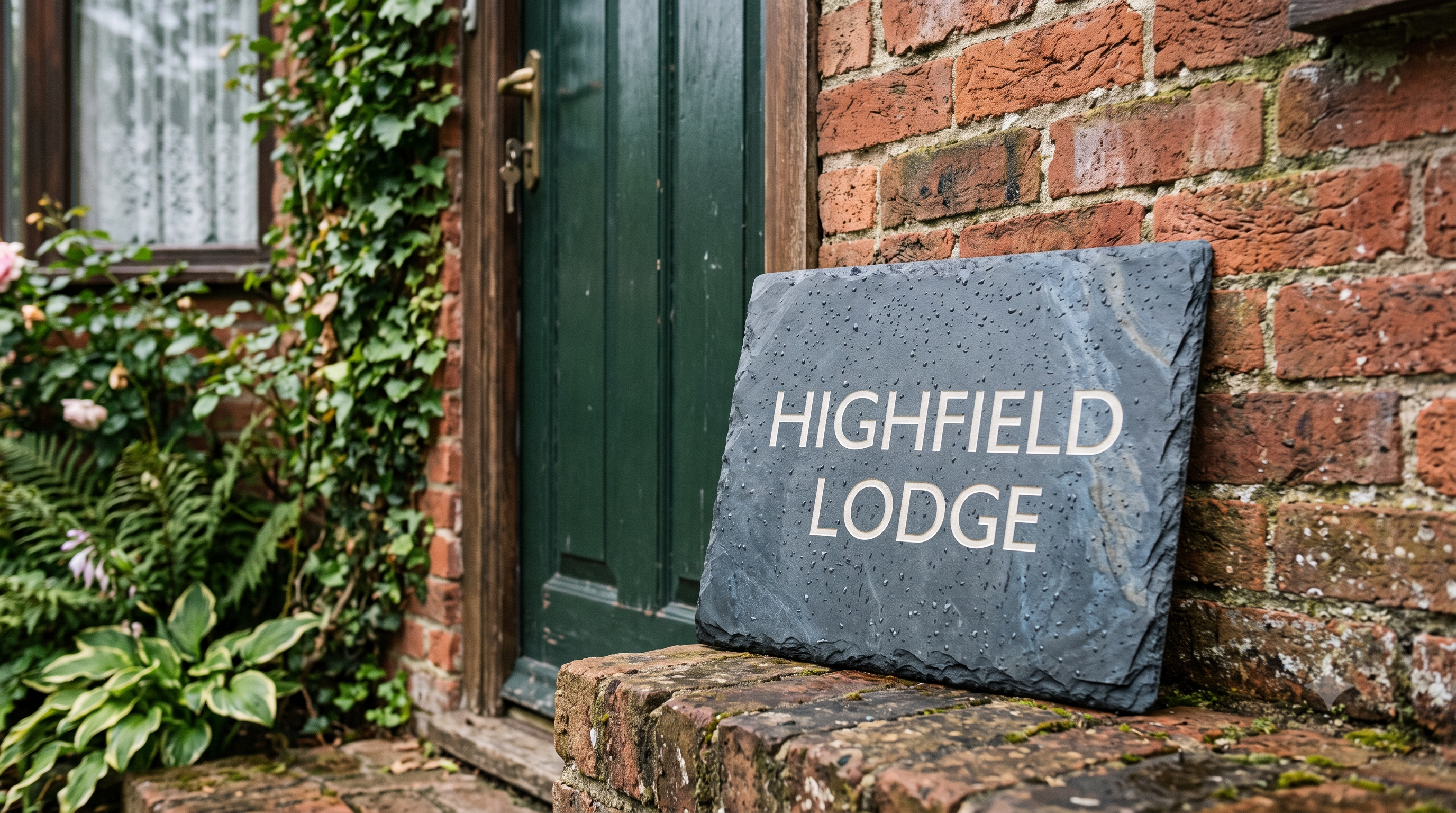
An engraved slate house sign has to do something most personalised gifts don't: survive outside, in British weather, for years, without fading. That single requirement shapes almost every decision we make when we cut one: the depth of the engraving, the finish we recommend, even the font. Here's what actually happens between a slate house sign order landing in our queue and a finished sign reaching someone's front door.
Slate arrives at the workshop as flat, pre-cut tiles rather than a single quarried block, so no two pieces are quite identical. Colour runs from charcoal to a warmer blue-grey, sometimes with faint mineral flecks running through it. We check each tile before it goes under the laser. A sign with an obvious crack, or a patch of discolouration where a house number needs to sit, gets set aside.
The engraving itself works differently to wood. On oak or bamboo, the laser chars the fibres, leaving a dark mark on a pale surface. Slate does the opposite. The laser removes a very thin layer of the natural surface, revealing the paler stone underneath. No ink, no paint, nothing sitting on top of the material that could eventually chip or peel. That's the main reason slate signs hold their legibility outdoors for years: there's nothing on the surface to weather away. The contrast is the stone itself.
Because the mark comes from the stone's own layering rather than a burn, consistency depends on where the tile came from. Two slate house signs cut from different batches can come out a shade apart, which is why we try to keep multi-piece orders (a house sign alongside matching slate coasters, say) cut from the same run of material where we can.
Too shallow, and a house number reads fine in bright sun but disappears at dusk or in the rain, when the stone's surface is wet and reflective. Too deep, and thinner tiles, the smaller sign sizes especially, lose strength at the edges of each letter. We adjust laser power by tile thickness rather than using one setting across the board. It's a small thing, but it's the difference between a sign that's still legible from the pavement in five years and one that isn't.
Most slate house sign orders fall into one of two categories: a straightforward number for a street address, or a house name for a cottage, a new build with a name the owners chose themselves, or a static caravan pitch. Fewer people order both together than you'd expect. A number on its own reads cleanly on a modern build, while an older cottage often only ever had a name and no number to begin with.
The other pattern worth mentioning: a large share of these orders aren't for the person buying them. Slate house signs are a common housewarming gift, bought by someone who's just watched a friend or relative complete on a house and wants to mark it with something more permanent than a card. If that's the occasion, it's worth checking the house name or number directly with the new owner rather than guessing from a moving announcement. We've had more than one order arrive with a charmingly wrong version of a name that changed after exchange.
We also see a fair number of repeat customers replacing a council-standard plastic number with something that actually suits an older property: a Victorian terrace or a stone cottage where the original number was a generic black-on-white plate screwed on decades ago. Slate tends to sit better against brick and stone than acrylic or printed alternatives, partly because it's a building material itself rather than something applied on top of one.
Once you've chosen a size for your personalised slate house sign and confirmed the wording (a house name, a number, sometimes both), that's when the clock starts. Production begins when your personalisation details are confirmed, not when the order is placed, so a clear, correctly spelled message at checkout genuinely speeds things up.
House numbers and names are short, which makes typos easy to miss. We ask customers to double-check spelling and spacing before submitting. "Rose Cottage" and "Rose Cottage " read identically on screen but not once they're cut into stone. If a detail looks ambiguous, we'll get in touch rather than guess.
Standard personalised orders are processed within 1–3 business days once wording is confirmed, then dispatched via Royal Mail or DPD depending on size, with UK delivery typically taking a further 2–4 business days. Slate travels in reinforced packaging with corner protection. It's a dense material, and a dropped parcel is more likely to chip a tile than a scratch would ever mark it.
Slate has roofed British buildings for centuries without a sealant in sight, so a house sign doesn't need one to survive outdoors. Customers ask us about this often enough that it's worth saying plainly: the engraving itself is weather-resistant by nature. What actually determines how well a sign holds up over time is where and how it's fixed to the wall, not what's been brushed onto the surface.
Not for legibility. A sealant can add a slight sheen if that's the look someone wants, but it isn't doing any protective work the stone doesn't already do on its own. We'd rather say that plainly than sell a finish nobody needs.
A covered porch or a wall under an overhang stays cleaner for longer. Exposed gate posts collect more grime and green algae over time, which is a cleaning issue rather than a fading one. Years of direct sun can lighten slate very slightly at the surface, but it happens evenly across the tile and doesn't affect the contrast of the engraving itself.
The font that looks elegant on a wedding place card is often the wrong choice on a house sign. Script and fine serif fonts blur at a distance, in low porch light, or when the stone is wet, exactly the conditions a house sign has to perform in most of the time. We steer customers toward simple sans-serif capitals, or a clean serif with enough stroke weight to read clearly from the pavement, not just up close.
Our house signs run from a small 150 x 300mm plaque up to a 300 x 400mm size, and character count has to shrink as the sign does. A long house name on the smaller size means thinner strokes, which is exactly where a delicate font starts to lose definition. On the larger sizes there's more room to be adventurous with lettering. On the smaller ones, we'll usually suggest simplifying the wording rather than shrinking the font to fit.
If you're planning one for a new house, a gate, or a shed door, the full range of sizes is on the personalised slate house sign page. For anyone furnishing the rest of the house to match, our personalised slate gifts collection includes personalised slate coasters cut from the same material, so a house sign and a set of coasters can share exactly the same finish.