Total: £0.00
Taxes and shipping calculated at checkout

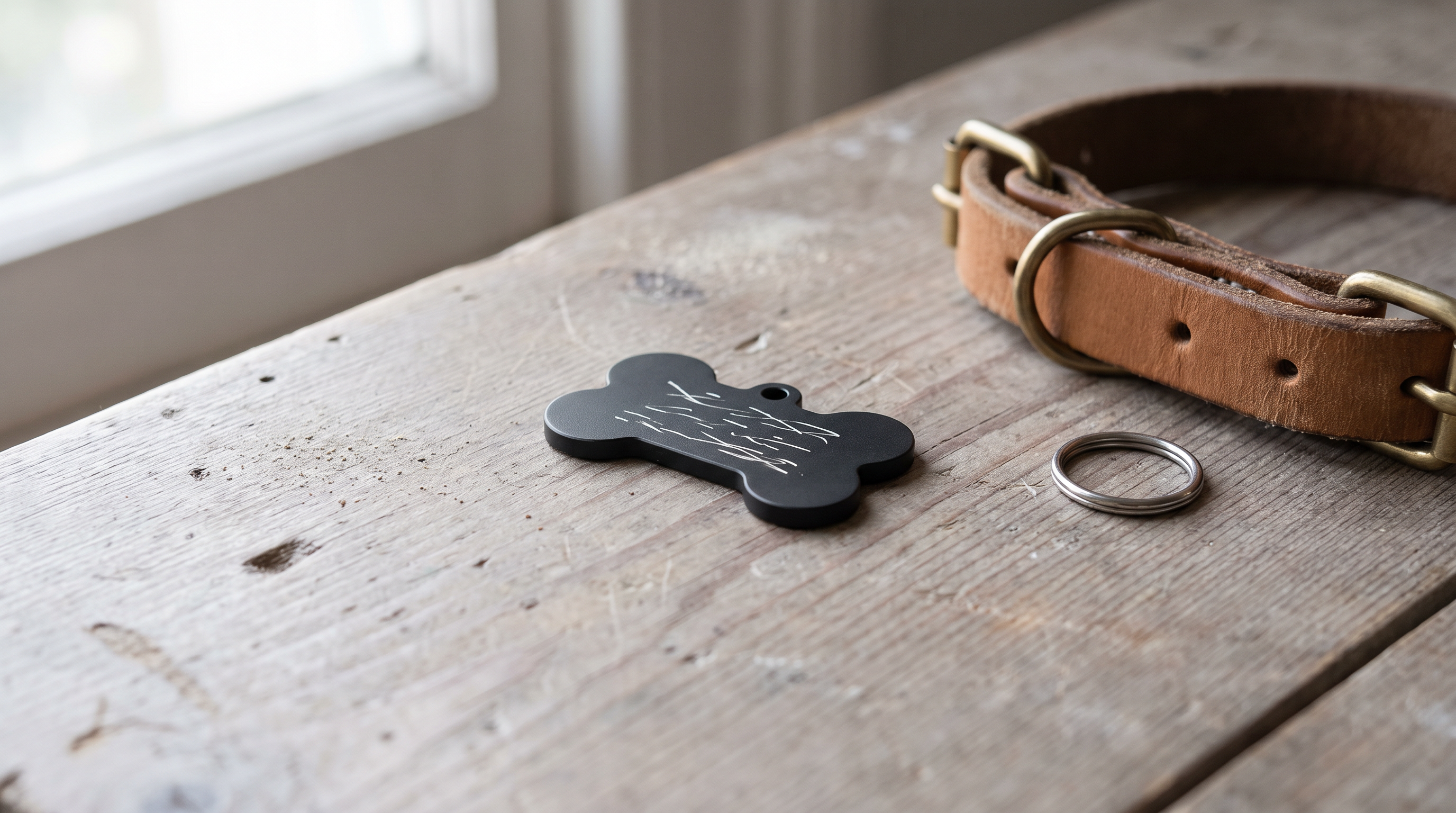
Every few weeks someone asks whether we make an engraved pet ID tag with a QR code on it. We don't, and the reason has less to do with technology than with what happens to a small piece of metal that spends two or three years swinging against a collar buckle in British weather.
What we do make is anodised aluminium. Tags come back to us for the ordinary reasons: a second dog, a name change after a rescue settles in, a replacement for one that went missing off the collar. That gives us a look at how they age. The part that wears is not the part most people expect.
The Control of Dogs Order 1992 is specific. A dog in a highway or a place of public resort must wear a collar with the name and address of the owner inscribed on the collar, or on a plate or badge attached to it. Name and address. Not a phone number, and not a link to a page holding that information.
A phone number is sensible and we recommend it, but it is an addition, not a substitute. This matters when you are choosing between an engraved pet ID tag with a QR code and a plain engraved one, because a tag carrying only a code does not put a name and address on the collar. It puts a pointer to them. The penalty on conviction runs to a four-figure fine, which is a poor return on a tag that cost a few pounds.
Microchipping does not change this. Chips have been compulsory for dogs in England, Scotland, and Wales since April 2016, and for cats in England since June 2024. A chip needs a scanner and a vet or a warden. A collar tag needs a stranger with a phone. They do different jobs, and the Order still asks for the tag.
We engrave tags. We do not give legal advice, and the Order is short enough to read in five minutes if you want to check the wording against your own situation.
The argument for a QR tag is real. A scannable code can hold more than four lines of text: medical notes, a second contact, a vet's number, and it can be edited without re-engraving anything. Some services send an alert when the code is scanned, with a location. For a dog with epilepsy or a serious allergy, that is worth something.
The costs are less often stated. The code has to resolve to a service that is still live and still paid for in three years. The finder needs a smartphone, signal where they found the dog, and the willingness to scan a code on a stranger's animal. And the code has to still scan.
That last point is where our own experience runs out, so we will be plain about it. QR codes carry Reed-Solomon error correction, and at the highest correction level roughly 30 per cent of the pattern can be damaged and the code still reads. That is why a scuffed printed code on a parcel usually works. But the failure mode on an engraved metal code is different from a scratched printed one. You do not lose isolated modules. You lose contrast across the whole face at once, evenly, and a scanner needs contrast before it needs data. We have not run engraved metal QR tags for years on live collars, so we cannot tell you where that threshold sits. Anyone who quotes you a figure is guessing.
What we can tell you is how engraving on anodised aluminium behaves, because we have watched that closely.
Anodising is a dyed oxide layer grown on the surface of the aluminium, usually somewhere in the 5 to 25 micron range on consumer parts. A laser does not cut into the metal. It ablates the dye and the oxide, exposing bare aluminium underneath. The letters are bright silver. The field around them is the colour you chose.
Which means the contrast works backwards from how people assume. The engraved text does not wear away, because it is the substrate. What wears is the colour around it. A black tag on an active dog goes charcoal, then grey at the edges, and the text gets harder to read not because the letters faded but because the background did.
The wear is not even, either. It concentrates at the split ring hole. The tag pivots on the ring all day and the top four or five millimetres take the abrasion, against the ring itself and against the collar buckle. So the top line of text is the first casualty.
The first: a contact number never goes on the top line. We put the surname there, because a surname is recoverable from an address and a number is not. If one line has to degrade, let it be the guessable one.
The second: 1.5mm cap height is our floor. Below that, on a bone shape, the ablation edge starts to bleed into the letterform and closed characters fill in. An 8 becomes a blob, an e becomes a c, a 9 becomes a 0 or a 6 depending on the light. We will not run text smaller than that, even when asked, because a tag nobody can read is worse than no tag at all.
The bone shape has its own constraint. It tapers, so lines one and four have less usable width than lines two and three. Twenty characters sits comfortably in the middle of the tag and gets cramped at the ends. When we lay out four lines a side, the long line goes in the middle.
Aluminium will not rust, which is the point of it on a wet UK collar. It also will not stay bright. Where the anodising has gone, the exposed metal oxidises to a dull grey. That is cosmetic and it does not weaken anything, but it is worth knowing before you order a gold tag and expect it to look gold in year three.
These are the patterns we see often enough to have opinions about.
Our personalised pet name tags with double-sided engraving are bone-shaped anodised aluminium, engraved on both faces, up to four lines a side at twenty characters a line, in ten colours, at £3.99. The same anodised aluminium turns up elsewhere in the range for the same reason it works here, including the engraved aluminium gift card and the rest of the personalised metal gifts.
A layout that works: side one carries the dog's name, large. Side two carries surname, house number and postcode, and a mobile, with the mobile on the second or third line rather than the first.
On timing. Personalised orders are processed within one to three business days, and UK delivery is a further two to four business days after dispatch. Business days are Monday to Friday, excluding bank holidays. Production starts when the personalisation details are confirmed, not when the order is placed, so an unclear or incomplete engraving instruction pushes the whole thing back.
If a tag arrives damaged, tell us within 24 hours and we will sort it; damaged returns need to be started within seven days of delivery. Personalised items are not returnable for a change of mind or for details supplied incorrectly.
A QR tag holds more information and can be updated. An engraved aluminium tag holds less, cannot be updated, and does not depend on anyone's server still being online, which is why it is what the law asks for. If you want both, run a QR tag alongside an engraved one rather than instead of it. We only make the second kind.
Choose your colour, keep the number off the top line, and check the spelling twice.